The Stranger at Our Door
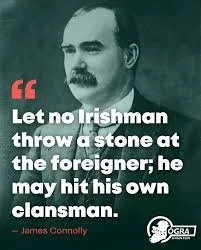
A mural in Cork reads: “Let no Irishman throw a stone at the foreigner; he may hit his own clansman.”
These words, spoken by James Connolly, hang over us like a question we haven’t quite answered.
For a nation whose people once fled hunger, eviction, and discrimination, whose identity was forged in exile, we have arrived at a strange moment. The same forces that pushed the Irish out into the world scarcity, desperation, the search for safety now bring others to our shores.
And our response, at least in some quarters, has not always been the solidarity our history might predict .
I often think about the psychology of belonging. Who is “us”? Who is “them”? These questions are not abstract they shape our politics, our communities, and the quiet conversations we have about who deserves a home here
The truth is, Ireland has a long, complex, and often painful history with ingroup and outgroup dynamics.
And if we want to understand why anti-immigrant sentiment thrives online today, we need to look at where it came from. Not to excuse it. To understand it. And to find a way out.
By Dr. Ann Cronin
Part 1: The Historical Architecture of "Us" and "Them"
Ireland’s patterns of social relationships have been marked by coercion and conflict for centuries . The AngloNorman invasion of 1169 began a long period of English rule a relationship built on dominance, dispossession, and the systematic dehumanisation of the Irish people.
By the 16th century, the English monarchy pursued a deliberate policy of “anglicisation.” Laws demanded the use of the English language and English customs. Irish identity was not simply subjugated it was criminalised. The Irish were depicted as barbaric, unruly, and in need of civilising . This is the original architecture of “othering”: one group defines itself as superior, rational, and deserving, while casting the other as inferior, threatening, and undeserving.
The Plantation of Ulster in the early 17th century formalised this dynamic. Land was confiscated from Catholic Irish landowners and granted to Protestant settlers from Scotland and England. The dispossessed became “the King’s Irish rebels”an outgroup within their own land .
This wasn't just economic policy. It was psychological warfare. The message was clear: you do not belong here.
Part 2: The Irish as "Other" – A Shared History of Exclusion
The irony of contemporary antiimmigrant rhetoric in Ireland is that it forgets how recently Irishness itself was stigmatised .
In the 19th century, the Irish in Britain were among the most despised minorities. AntiIrish racism was common in media and everyday life, reproducing stereotypes of the “dirty”, “drunken”, or “violent” Irishman. Landlords and employers blacklisted Irish names. Signs reading “No Blacks, No Dogs, No Irish” were not apocryphal they were real. The Irish were racialised as “white but inferior, European yet uncivilised” .
This history is not ancient. It lives in the memory of our parents and grandparents. It shapes the sensitivity and sometimes the defensiveness of Irish identity today. A people who were once the “foreigner” have not always found it easy to recognise the foreigner in themselves.
As one study noted, the prejudice that once targeted the Irish is now, at times, reproduced by them .
Part 3: Modern Ireland – The Double Movement
The Celtic Tiger period transformed Ireland. For the first time in generations, the country experienced larges cale immigration rather than emigration. Between the mid1990s and the late 2000s, Ireland saw large influxes of both returning Irish citizens and nonIrish inmigrants .
Returning Irish citizens faced their own form of dislocation. One study noted that return is commonly described as “coming home,” but this description overlooks the fact that through mobility, our connections to particular places are multiple and transformative. Belonging is not automaticit is negotiated .
For many settled Irish people, this period was disorienting. The country they grew up in was changing rapidly. And when people feel disoriented, they often look for someone to blame.
The 2004 Citizenship Referendum, which removed automatic birthright citizenship, was a turning point. As one analysis notes, it reflected a shift toward jus sanguinis (right of blood) over jus soli (right of soil)a more ethnic, less civic definition of Irishness . The question quietly became: Who is really Irish
Part 4: The Online Breeding Ground – How History Meets Technology
Fast forward to 2025. A report by the Hope and Courage Collective found that a relatively small number of far right actors disproportionately influence public debate through online amplification, visible protests, and repeated narratives .
Public attitudes are actually becoming more inclusive. The report shows that 66% of Irish people agree that immigrants contribute positively to Irish culture up from 64% in 2024. 80% agree that Black, Asian and minority ethnic communities face greater barriers to success up from 75% .
But the minority narrative is louder. And it draws on deep, historically conditioned fears.
How the Far Right Uses Irish History
The report identifies a strategic shift in messaging from system focused narratives like “Ireland is full” towards more explicit identity based claims such as “Irish Lives Matter.” Symbolic actions, including the appropriation of national symbols like the Irish tricolour, have been used to project a sense of momentum beyond the movement’s actual size .
The tricolour, once a banner of anticolonial unity, now also appears as a boundary marker of who counts as “Irish.” During a protest in Cork, the same flag flew above two opposing crowds: one calling for justice and liberation, the other invoking nationalism and exclusion .
Similarly, the term “plantation” has been repurposed by far right groups like Sinne na Daoine to depict asylum seekers as an invading, enemy force. This is an Irish version of the “Great Replacement” conspiracy theory a language that weaponises historical trauma for political ends .
How Social Media Amplifies the Pattern
There is now a depressingly familiar pattern to how violence unfolds:
When news emerges of an alleged crime, posts, videos, and calls to action, tying the incident to migration, immediately appear online. A popular video posted on numerous platforms features a person saying “a child’s been attacked. This was entirely preventable, our politicians created this” .
On X (formerly Twitter), users reply: “We need to go to war over this.” On Facebook, one user replied with a meme still live at the time of reporting showing people being hung from a gallows. The intent was clear .
During the Citywest riots in October 2025, individuals from the UK and Canada travelled to Ireland specifically to attend and create content from the protest. Livestream content depicting violence was broadcast on YouTube, TikTok, and Twitch, with streamers rewarded by viewer donations as they captured protesters shouting racist expletives. In one eight minute segment, a user broadcast the burning of a Garda van, referred to migrants in horrific terms, and received the equivalent of €56 in donations .
The notion that violence can be monetised on social media illustrates a glaring failure of platforms to adequately enforce their own community guidelines. Yet the pattern is familiar: Dublin riots in November 2023, violence in Ballymena, arson attacks on accommodation centres since 2018 .
Part 5: The Psychological Mechanism – InGroup Projection and Scapegoating
Social identity theory helps explain what is happening. When a group feels threatened economically, culturally, or symbolically it can respond by intensifying its identification with the ingroup and denigrating the outgroup.
Research on the Northern Irish conflict found that both Protestant and Catholic groups viewed “Northern Ireland” as the most inclusive superordinate category. However, the Protestant group engaged in ingroup projection perceiving a large overlap between their own identity category and the superordinate category . In other words: We are the real Northern Ireland.
The same dynamic plays out nationally: We are the real Irish.
When people feel anxious about change, when housing is unaffordable, when public services are stretched, the psychological pull is toward simplicity. A villain. A cause. A group to blame.
The 2025 Hope and Courage report notes that while the majority of Irish people reject farright narratives, the farright “is shaping the conversation” . This is the danger. A small, loud, online minority can set the terms of debate not because they represent the people, but because they have mastered the psychology of fear, the speed of social media, and the power of historical grievance weaponised.
Part 6: The Path Forward – From Othering to Solidarity
The same report tells a different story: 79% of Irish people believe working class people are struggling due to systemic inequality. 69% believe wealthy people are successful because they were given more opportunities .
People want solutions. They don't want scapegoats.
The Hope and Courage Collective found that “communities across Ireland are actively building inclusive, resilient, and welcoming places and are stepping up during moments of crisis” . This is not naive optimism. It is documented.
James Connolly’s words still ring across the decades: “Let no Irishman throw a stone at the foreigner; he may hit his own clansman.”
The Irish psychologist in me sees the warning. The human in me sees the possibility. We have been the stranger. We know what it feels like to be unwanted. That memory is not a weapon it is a resource.
The question is whether we will use it.
For my clients migrants, returnees, and settled Irish alike the psychological work is often the same: belonging takes time. It is not automatic. It is not guaranteed by a passport. It is built in small moments of recognition, of welcome, of shared humanity.
When we understand that the fear of the “other” is a conditioned response historically shaped, socially reinforced, and online amplified we can also understand that it can be unlearned. Not quickly. Not easily. But together.
Dr. Ann Cronin, PhD
If you are struggling with questions of belonging whether you have arrived in Ireland, returned home, or never left you are not alone. Book a free discovery call. No pressure. Just a conversation about where you belong.
References
Cochrane, G. (1972). Britannic Irish and Hibernian Irish in Ulster's racial conflict. Sociologus
Hope and Courage Collective. (2026). Ireland in Focus 2025, Mind the Gap. RTÉ News
O'Connor, C. (2025). 'This is our country, get them fing out': Citywest riot raises questions for social media giants. The Irish Times
University College Cork. (2026). “Let No Irishman Throw a Stone at the Foreigner”: Remembering and Forgetting Solidarity in Contemporary Ireland
Willer, D., et al. (2022). Patterns of Social Relationships and Their Outcomes: The Case of Ireland. International Journal of Sociology